 (888) 999-1405
What Is the Debt Service Coverage Ratio (DSCR) and Why Lenders Use It
The debt service coverage ratio, or DSCR, is one of the first numbers a lender checks before approving a business loan. It measures whether a business generates enough cash flow to cover its debt payments. Lenders use it to decide how much risk they’re taking on, and how much they’re willing to lend.
This guide is for small business owners, borrowers exploring financing options, and anyone preparing to apply for an SBA loan, term loan, or line of credit. You don’t need an accounting background to understand it or calculate it yourself.
What Is the Debt Service Coverage Ratio (DSCR)?
DSCR is a financial ratio that compares a business’s net operating income to its total debt obligations for a given period, usually a year. In simple terms, it answers one question: for every dollar of debt payment due, how many dollars of income does the business have available to cover it?
The formula:
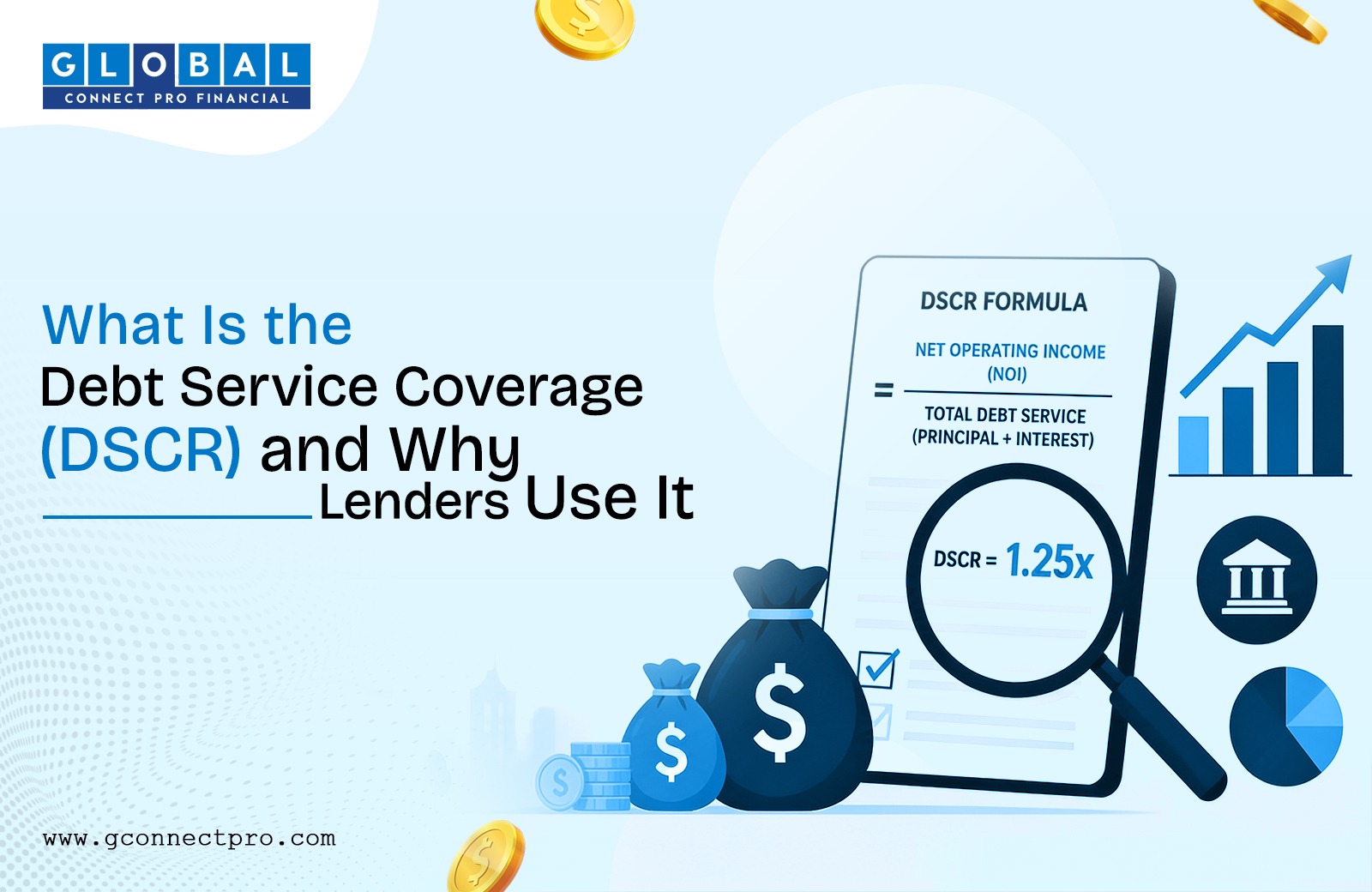
DSCR = Net Operating Income ÷ Total Debt Service
- Net Operating Income (NOI): Revenue minus operating expenses, before interest, taxes, depreciation, and amortization
- Total Debt Service: All debt obligations due in the period – principal and interest on existing loans, plus the new loan being applied for
A DSCR of 1.0 means the business generates just enough income to cover its debt payments, leaving no additional cash flow.
When the DSCR is above 1.0, the business has a financial cushion after meeting its debt obligations.
With a DSCR below 1.0, operating income is not sufficient to fully cover the business’s debt payments.
DSCR vs. Other Common Lending Ratios
Business owners often confuse DSCR with other financial ratios lenders reference. They measure different things.
| Ratio | What It Measures | What It Tells a Lender |
|---|---|---|
| DSCR | Operating income vs. total debt payments | Can the business afford this loan from cash flow? |
| Debt-to-Income (DTI) | Total debt vs. gross income | How leveraged is the borrower overall? |
| Current Ratio | Current assets vs. current liabilities | Can the business cover short-term obligations? |
| Debt-to-Equity | Total debt vs. owner’s equity | How much of the business is financed by debt vs. ownership? |
DSCR is the most direct measure of repayment ability specifically tied to the loan being requested, which is why lenders weight it so heavily in the approval decision.
Why Lenders Use DSCR
Lenders use DSCR because it directly answers their core underwriting question: will this business be able to make its payments without straining its operations? A business can look profitable on an income statement and still carry too much debt relative to what it actually brings in each month.
The Small Business Administration and most conventional lenders set minimum DSCR thresholds for loan approval, and many require a DSCR of at least 1.25 for commercial lending products – meaning the business needs to generate 25% more income than its debt payments require. This buffer protects both the lender and the borrower against a slow month, an unexpected expense, or a dip in revenue.
What a Low DSCR Signals to a Lender
A DSCR below the lender’s minimum threshold raises specific concerns:
- Thin or inconsistent cash flow relative to existing obligations
- Limited buffer for a slow season or unexpected cost
- Higher likelihood of missed or late payments
- Reduced approval odds, or approval only at a smaller loan amount or higher interest rate
How DSCR Affects Loan Terms
DSCR doesn’t just determine approval or denial – it often shapes the terms of the loan itself. A stronger DSCR can lead to:
- A higher approved loan amount
- More favorable interest rates
- Longer repayment terms
- Fewer required collateral conditions
A borderline DSCR, on the other hand, may still result in approval, but often with a smaller loan, a shorter term, or additional conditions like a personal guarantee.
How to Calculate Your Own DSCR Before Applying
Business owners can estimate their DSCR before submitting a loan application. Here’s the practical process:
- Pull net operating income from the most recent 12 months of financials (revenue minus operating expenses, before interest and taxes)
- List all existing debt obligations due in that same period – principal and interest
- Add the estimated annual payment for the new loan being requested
- Divide net operating income by the total debt service figure
Running this calculation before applying helps identify whether a business is likely to qualify, and at what loan amount, before going through a formal underwriting process.
Ways to Improve DSCR Before Applying
A business with a DSCR below the lender’s threshold isn’t necessarily out of options. Several practical steps can improve the ratio before reapplying:
- Pay down or consolidate existing high-payment debt to reduce total debt service
- Increase net operating income by cutting non-essential operating expenses
- Delay large discretionary purchases until after loan approval
- Extend the term on existing debt to lower monthly payment obligations
- Wait for a stronger revenue quarter before submitting financials
Conclusion
DSCR is one of the clearest signals a lender uses to judge whether a business can responsibly take on new debt. Understanding how it’s calculated – and what pushes it up or down – gives business owners a real advantage going into a loan application. A strong DSCR doesn’t just improve approval odds; it often means better rates and terms too. Before applying for an SBA loan, term loan, or line of credit, it’s worth calculating your DSCR and addressing any gaps ahead of time.
This article offers general financial guidance and is not a substitute for advice from a licensed financial advisor or lender. Loan terms, DSCR thresholds, and underwriting criteria vary by lender and loan product. Speak with a lending specialist to understand what applies to your specific situation.
FAQ,s
Q1. What is the debt service coverage ratio (DSCR)?
DSCR is a financial ratio that measures a business’s net operating income against its total debt payments. It tells lenders whether a business generates enough cash flow to cover its debt obligations.
Q2. What is considered a good DSCR?
A DSCR of 1.25 or higher is generally considered strong by most commercial lenders. A ratio below 1.0 means the business isn’t generating enough income to cover its debt payments from operations alone.
Q3. How is DSCR calculated?
DSCR is calculated by dividing net operating income by total debt service (all principal and interest payments due, including the new loan being applied for).
Q4. Why do lenders care about DSCR more than revenue?
Revenue alone doesn’t account for expenses or existing debt obligations. DSCR shows what’s actually left over to cover payments, which is a more accurate measure of repayment ability.
Q5. Can a business get a loan with a DSCR below 1.0?
It’s possible but difficult. Some lenders may approve a loan with additional conditions, such as a smaller loan amount, higher interest rate, or personal guarantee, but many will decline outright.
Q6. What’s the difference between DSCR and debt-to-income ratio?
DSCR measures operating income against debt payments specifically tied to a business or loan. Debt-to-income ratio measures total debt against gross income more broadly, often used in personal or real estate lending.
Q7. How can a business improve its DSCR?
Paying down existing debt, reducing operating expenses, extending loan terms, and waiting for a stronger revenue period can all improve DSCR before reapplying.
Q8. Does DSCR affect loan terms, not just approval?
Yes. A stronger DSCR often leads to a higher approved loan amount, better interest rates, and longer repayment terms. A borderline DSCR may still be approved, but usually with more conservative terms.
Q9. Is DSCR used for all types of business loans?
DSCR is commonly used for SBA loans, term loans, and commercial real estate loans. It may be weighted differently depending on the lender and loan product.
Q10. How often should a business check its DSCR?
Reviewing DSCR annually, or before any major financing decision, helps a business understand its borrowing capacity and catch declining cash flow trends early.